Your post-event content needs a different architecture

Updated: Sep 9
Major events take everything your team has. The months of planning, the sleepless nights before, the adrenaline of execution. And then the event ends, the guests go home, and the team collectively collapses.
And somewhere on a hard drive is everything you captured. The interviews. The panel discussions. The keynote moments. The smaller conversations that nobody will remember to come back to.
The standard approach says: post everything within 3-5 days while the momentum is still alive. But that instruction lands on the most depleted version of your team, at the moment they have the least capacity to execute it well. The result is that the urgent gets out — VIP speeches, keynotes, the names that feel most time-sensitive. Everything else gets quietly abandoned.
Not because it wasn't valuable. Because the urgency window closed before anyone got to it.
The problem is that every post-event content plan is written for an energised team and executed by an exhausted one.
What if there is a different way to think about this?
The core shift: From calendar to architecture
A content calendar treats every post-event asset as an equal item on a to-do list. A content architecture treats the event as a single dataset and sequences how that dataset gets processed — protecting the team's most depleted period while ensuring nothing gets abandoned.
The Hub-and-Spoke model is built on one principle:
Compile everything once. Distribute everything from that single source.
Instead of asking an exhausted team to make dozens of simultaneous creative decisions — what to clip, how to frame it, which format, which audience, by when — the model collapses all of that into one focused synthesis pass. Once the synthesis is done, every subsequent asset becomes a lower-effort extract from a single approved source of truth.
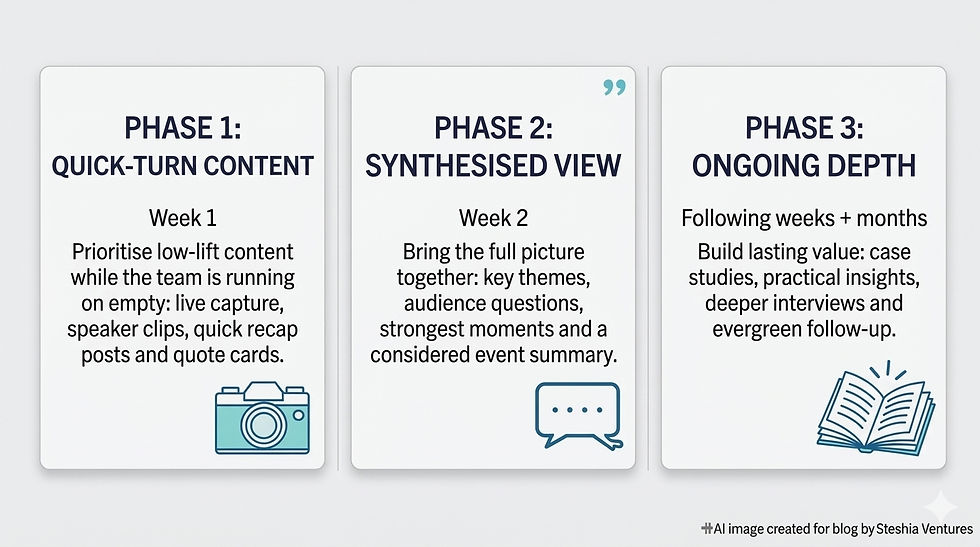
Phase one: The Signal Week (Days 1-7)
This is the week your team is running on empty and your audience is still paying attention.
Do not ask your team to make complex creative decisions this week. The content that belongs here is low-effort and high-visibility — crowd photos, executive thank-yous, press releases, basic event highlights. Atmosphere, not analysis.
Give your creative team 72 hours of complete rest before they open any editing software. This is not optional. The quality of everything that follows depends on it.
The Signal Week is not about maximising content. It is about maintaining presence while protecting the people who have to produce everything else.
Phase two: The Intelligence Phase (Days 8-30)
This is when the real work happens — and it is one focused piece of work, not many.
Your team synthesises everything from the event into a single Master Hub document. Three to five pages. Major themes, unexpected insights, standout quotes, key statistics, decisions made, perspectives shared. Everything the event produced, distilled into one trustworthy source.
This document is not published. It is the internal source of truth from which everything else is extracted.
Why does this save the team? Because digesting raw event material — hours of footage, pages of notes, dozens of interviews — is cognitively expensive work. Doing it once, into a single document, is far less exhausting than doing it ten times for ten different assets. Once the Hub exists, the thinking is done.
The Master Hub also forces something the content calendar never does: it requires the team to identify the three or four themes that actually define the event, before any asset is produced. Every subsequent post, clip, graphic, and email is then built around those themes — rather than becoming a random collection of disconnected moments.
Phase three: The Evergreen Phase (Days 31-90+)
This is where the content that sat on the hard drive finally gets its moment — not as an afterthought, but as a deliberate, phased release designed for an audience that is now ready for depth rather than highlights.
The guest interviews. The panel discussion clips. The smaller conversations. Each one gets released as a standalone asset, with proper context, a clear reason for the audience to engage, and space to perform without competing with everything else.
This phase runs for weeks or months, feeding your content channels systematically rather than flooding them in a single exhausted rush.
And here is the thing about the content that sat on the hard drive: it did not lose its value. What a guest shares that’s filmed at a milestone event are just as relevant in month two as they were on day five — if they are released with intention rather than desperation.
The asset hierarchy
Think of it as three levels, each feeding the next:
Level one — The Master Hub
The single synthesis document. High cognitive effort, done once. Internal audience first, then published as an event report or executive brief for attendees and leadership.
Level two — Deep dives
Topic-specific blog posts, email newsletters, podcast episodes — each extracted directly from a section of the Master Hub. Medium effort, because the thinking is already done.
Level three — Micro-content
Quote cards, short video clips, carousel slides, stat callouts — batch-produced from Levels one and two. Low effort, because the source material and the framing already exist.
The key discipline: never start at Level three. Starting with micro-content forces the team to re-watch, re-read, and re-orient to raw event material multiple times — for every single asset. Starting with the Hub means the material is digested once and the micro-content follows automatically.
What this is not
This is not a guarantee that everything gets produced. Major events generate more content than any lean team can fully execute, regardless of the system.
What the Hub-and-Spoke model does is ensure that what gets produced is the most valuable content, released in the right sequence, for the right audience, at the right moment — rather than whatever happened to feel most urgent on day three when the team was running on nothing.
It does not eliminate exhaustion. It reduces the cognitive load that exhaustion makes unbearable.
Where to start
If your next major event is coming up, build the architecture before the event, not after it.
Define your three phases and their timelines. Decide what belongs in phase one before the event ends — so the Signal Week runs without decisions. Create the Master Hub template in advance — so the synthesis in phase two has a structure to fill rather than a blank page to face.
If your event already happened and the hard drive is sitting there — start with the Hub. Block one day. Synthesise everything into three to five pages. Once that document exists, the rest of the content has somewhere to come from.
The event is over. The content doesn't have to be.
Interested in building out this three-phase architecture that makes this possible? Let’s chat. Drop a comment below or send me a message.

Comments